Such were the things that happened in connection with Lysimakhos. The Athenians have also a likeness [eikōn] of Pyrrhos. This Pyrrhos was not to Alexander, except by way of genealogy [genos]. Pyrrhos was son of Aiakidēs, son of Arybbas, but Alexander was son of Olympias, daughter of Neoptolemos, and the father of Neoptolemos and Arybbas was Alketas, son of Tharypos. And from Tharypos to Pyrrhos, son of Achilles, are fifteen generations [geneai]. Now, Pyrrhos was the first who after the capture of Troy disdained to return to Thessaly, but sailing to Epeiros dwelled there following the oracular-pronouncements [khrēsmoi] of Helenos. By Hermione Pyrrhos had no child, but by Andromache he had Molossos, Pielos, and Pergamos, who was the youngest. Helenos also had a son, Kestrinos, being married to Andromache after the killing of Pyrrhos at Delphi.
Helenos on his death passed his rulership [arkhē] to Molossos, son of Pyrrhos, so that Kestrinos with volunteers from the people of Epeiros took possession of the region beyond the river Thyamis, while Pergamos crossed into Asia (Minor) and killed Areios, despot in Teuthrania, who fought with him in single combat for the rulership [arkhē], and gave his name to the city which is still called after him.1 For Andromache, who accompanied him, there is still a hero-shrine [hērōion] in the city.2 Pielos remained behind in Epeiros, and to him as ancestor Pyrrhos-son-of-Aiakidēs and his fathers traced their descent, and not to Molossos.
Footnotes
Down to the time of Alketas, son of Tharypos, Epeiros too was under one king. But the sons of Alketas after a quarrel agreed to rule with equal remaining faithful to their compact; and afterwards, when Alexander, son of Neoptolemos, died among the Leukanoi, and Olympias returned to Epeiros through fear of Antipatros, it was Aiakidēs, son of Arybbas, who continued in allegiance to Olympias and joined in her campaign against Aridaios and the Macedonians, although the men of Epeiros refused to accompany him.
Olympias on her victory behaved in-unholy-ways [an-hosia] in the matter of the death of Aridaios, and in even more-unholy-ways [an-hosia] with regard to certain Macedonian men, and for this reason was considered to have deserved her subsequent treatment at the hands of Kassandros; so Aiakidēs at first was not received even by the people of Epeiros because of their hatred of Olympias, and when afterwards they forgave him, his return to Epeiros was next opposed by Kassandros. When a battle occurred at Oineadai between Philip-brother-of-Kassandros and Aiakidēs, it was Aiakidēs who was wounded and who shortly after met what was fated [tò khreōn].1
Footnotes
-
↩
313 BCE.
The people of Epeiros accepted Alketas as their king, being the son of Arybbas and the elder brother of Aiakidēs, but of an uncontrollable temper [thūmos] and on this account banished by his father. Immediately on his arrival he began to take out his insanity [mainesthai] on the people of Epeiros, until they rose up and put him and his children to death at night. After killing him they brought back Pyrrhos-son-of-Aiakidēs. No sooner had he arrived than Kassandros made war on him, while he was young in years and before he had consolidated his empire [arkhē]. When the Macedonians attacked him, Pyrrhos went to Ptolemy, son of Lagos, in Egypt. Ptolemy gave him as wife the half-sister of his children, and restored him by way of an Egyptian force.
The first of the Greeks [Hellēnes] that Pyrrhos attacked on becoming king were the people of Corcyra. He saw that the island was near his own territory, and he did not wish others to have a base from which to attack him. My account of Lysimakhos has already how he [= Pyrrhos] fared, after taking Corcyra, in his war with Lysimakhos—how he expelled Demetrios and ruled Macedonia until he was in turn expelled by Lysimakhos, the most important of his achievements until he waged war against the Romans,
being the first Greek [Hellēn] we know of to do so. For no further battle, it is said, took place between Aeneas and Diomedes with his Argives. One of the many ambitions of the Athenians was to reduce all Italy, but the disaster at Syracuse1 prevented an encounter then with the Romans. Alexander, son of Neoptolemos, of the same family as Pyrrhos but older, died among the Leukanoi before he could engage the Romans in battle.
Footnotes
-
↩
413 BCE.
subject heading(s): Pyrrhos the hero, Pyrrhos the king
Pausanias at 1.11.1 begins here his narrative about Pyrrhos-son-of-Aiakidēs, king of Epeiros. I have already noted that Pyrrhos claimed as his ancestor, counting twenty generations backward in time, the Greek hero Pyrrhos-son-of-Achilles. (Pausanias complicates the numbering by starting with an ancestor that goes five generations back and then adding fifteen generations more.) This hero was otherwise known as Neoptolemos, meaning ‘renewer of war’. As for his name Pyrrhos, it means ‘fiery red’. Both names are most apt, because the hero Pyrrhos/Neoptolemos is traditionally pictured in the verbal and visual arts of the ancient Greeks as a veritable killing machine—whose fiery temperament in war replicates and thus renews the deadliest wartime moments of his father. In the case of Achilles, we find a horrific example of such a moment at Iliad 21.328–384, where the hero goes berserk as he proceeds to slaughter, one after the next, all the fleeing Trojan warriors whom he overtakes in his murderous progression of martial fury: the more blood he spills, the more furious he gets—until he becomes the embodiment of fire itself, since the poetry of the Iliad now merges this warrior’s rage with the cosmic power of Hephaistos as the god of raging fire. In the case of Pyrrhos/Neoptolemos, such horrific moments of martial fury are further augmented and multiplied: examples include the fiery hero’s slaughtering of Priam the old king, of Polyxena the beautiful princess, and of prince Astyanax, hapless child of Hector and Andromache.
A moment ago, I described the hero Pyrrhos as ‘fiery’ in such contexts of martial fury. I will now elaborate, epitomizing from an earlier work (BA 122, 7§5; 330–332, 20§12).
My description ‘fiery’ matches the hero’s name Púrrhos, deriving from the adjective purrhós, meaning ‘fiery red’, which in turn derives from the noun *pûr *‘fire’. The description matches also the association of this hero with a kind of war dance known as the purrhíkhē—a word that likewise derives from the adjective purrhós. Here is a basic definition of the *purrhíkhē *as we find it in the ancient lexicographical tradition attributed to Hesychius (under the entry πυρριχίζειν): τήν ἐνόπλιον ὄρχησιν καὶ σύντονον πυρρίχην ἔλεγον ‘the word for energetic dancing in armor was purrhíkhē’. In the work that I am epitomizing, I offered detailed evidence to show that this kind of war dance was a ritual dramatization of *biē *‘force, violence’ in warfare. I hold back on repeating the details here, except to add that the noun *purrhíkhē *is appropriate to the name Púrrhos, not only to the adjective purrhós, since there are myths that derive the name of the war dance from the name of the hero. According to the poetry of Archilochus (F 304W), for example, the word *purrhíkhē *refers to a war dance because *Púrrhos *danced such a war dance for joy after he killed the hero Eurypylos in the Trojan War. According to another tradition, mentioned by Lucian (On dance 9) and by other sources, *Púrrhos *not only “invented” the purrhíkhē: he also captured Troy through the ignition of this war dance, since he started the fire that burned down the city when he leapt out of the Wooden Horse, already dancing his dance and thus igniting the fire.
As we have already seen, the hero Pyrrhos/Neoptolemos is traditionally pictured in the verbal and visual arts of the ancient Greeks as a veritable killing machine—whose fiery temperament in war replicates and thus renews the deadliest wartime moments of his father. And yet, before the Trojan War begins, Pyrrhos can be pictured as a most contemplative young man. He turns into a fiery killing machine only after he arms himself with the armor of Achilles. As we know from the plot summary of the Little Iliad, which is part of the so-called epic Cycle, this armor is handed over to Pyrrhos by Odysseus (p. 107 lines 29–30 ed. Allen 1912). I show here a close-up from a vase painting by Douris, dated at around 490 BCE, which pictures a moment when Pyrrhos the hero reaches out to receive the helmet of his dead father, Achilles. The expression on the hero’s face is still composed and collected as he contemplates the helmet that he holds delicately in his hand. But the profile of the helmet that is facing him seems to have a face of its own, a dead face that is staring back at Pyrrhos, returning the young man’s gaze. The dead face is radiating its own vision of death in war.
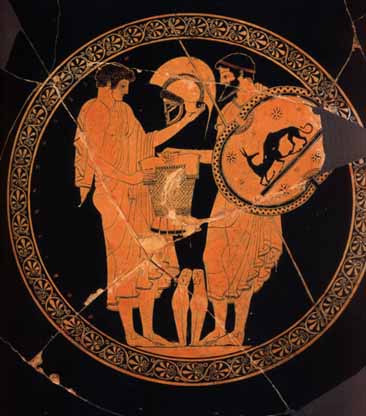
[Pyrrhos holding the helmet of Achilles as he receives the armor of Achilles from Odysseus. 500–450 BCE, by the painter Douris. Image via Wikimedia Commons.]