Leading from the Prytaneion [‘City Hall’] is a road called Tripods [Tripodes]. The place [khōríon] takes its name from the shrines [nāoi], large enough to hold the tripods [tripodes] that stand upon them, of bronze, and containing works of artisanship that are most worthy of remembering [mnēmē], including a Satyr, of which Praxiteles is said to have thought-of [phroneîn] very highly. Once upon a time, Phryne asked him which of his works [erga] was the most beautiful of them all, and they say that he agreed to give that one as a gift [to her], but he refused to say which of his works appeared to him to be the most beautiful of them all. Well, a slave of Phryne rushed up to Praxiteles saying that a fire had broken out in his building and that the greater number of his works [erga] were lost, though not all were destroyed.
Praxiteles at once started to rush out the door saying that his labor was all lost if in fact the fire [phlox] had caught his Satyr and his Love [Eros]. But Phryne ordered him to stay and be of good courage, for he had suffered no grievous loss, but had been trapped into confessing which were the most beautiful of his works. So, Phryne chose the statue of Love [Eros]; meanwhile, a Satyr is in the temple of Dionysus close by—a boy holding out a cup. The Love [Eros] standing with him and the Dionysus were made by Thymilos.
The oldest sanctuary [hieron] of Dionysus is near the theater. Within the enclosure [peribolos] are two temples [nāoi] and two statues of Dionysus, the Eleuthereus [‘Deliverer’] and the one that Alkamenes made of ivory and gold. There are paintings [graphai] here. One of them shows Dionysus bringing up [an-agein] Hephaistos to the sky [ouranos]. And the following things are also said about this by the Greeks [Hellēnes]: Hephaistos, when he was born, was thrown down by Hērā. In revenge, he sent to her as a gift a golden throne [thronos] with invisible bonds [desmoi]. When Hērā sat down she was held bound, and Hephaistos refused to listen to any other of the gods except for Dionysus—in him he placed the fullest trust—and after making him drunk Dionysus brought him to the sky [ouranos]. Also painted [on the wall painting] are Pentheus and Lycurgus (Lukourgos) paying the penalty [dikē] for having committed-outrage [hubrizein] against Dionysus; also Ariadne, asleep; Theseus, departing by sea; and Dionysus, arriving to abduct [harpazein] Ariadne.
Near the sanctuary [hieron] of Dionysus and the theater is a structure that is said to be a replica [mīmēsis] of the tent [skēnē] of Xerxes. It has been rebuilt, for the old building was burned down by the Roman general [stratēgos] Sulla when he captured Athens.1 The cause [aitiā] of the war was this. Mithridates was king over the barbarians [barbaroi] around the Black Sea [Pontos Euxeinos]. Now his pretext [prophasis] for making war against the Romans, and how he crossed into Asia [Minor], and what cities he took by force of arms or made his friends, I must leave for those to find out who wish to know the things concerning Mithridates. What I will highlight here is the capture of Athens.
Footnotes
-
↩
86 BCE.
There was an Athenian, Aristion, whom Mithridates used as his envoy to the Greek [Hellēnides] cities. He persuaded the Athenians to join Mithridates rather than the Romans, although he did not persuade all, but only the common-people [dēmos] and, in particular, the most turbulent part of the common-people [dēmos]. But those Athenians who were of any account [logos] fled to the Romans of their own accord. In the engagement that followed, the Romans won a decisive victory; Aristion and the Athenians fled and were pursued right into the city [of Athens itself], while Arkhelaos and the barbarians were pursued right into the [harbor city of] Peiraieus. This Arkhelaos was another general of Mithridates, whom earlier than this the Magnesians who inhabit [oikeîn] the region of Mount Sipylos wounded when he raided their territory, killing most of the barbarians as well. So, Athens was besieged.
Taxilos, a general [stratēgos] of Mithridates, was at the time besieging Elateia in Phokis, but, on receiving the news, he withdrew his troops towards Attica. Learning this, the general [stratēgos] of the Romans entrusted the siege of Athens to a portion of his army, and with the greater part of his forces advanced in person to engage Taxilos in Boeotia. On the third day from this, news came to both the Roman armies; Sulla heard that the Athenian fortifications had been breached, and the besieging force learned that Taxilos had been defeated in battle near Khairōneia. When Sulla returned to Attica he rounded up inside the Kerameikos the Athenians who had opposed him, and one chosen by lot out of every ten he ordered to be led to execution.
Sulla did not relent in his anger against the Athenians, and so a few who managed to escape to Delphi inquired there whether the time had now come when it was fated for even Athens to become a deserted place. The Pythia said-in-an-oracular-pronouncement [khrē-] the-things-having-to-do-with the ‘wine-skin’ [askos]. Afterwards, Sulla was afflicted with that disease [nosos], which I learn also afflicted Pherecydes of Syros. Although Sulla treated the Athenian people in a way that was so savage as to be unseemly for a Roman, I do not think that this was the cause [aitiā] of his misfortune [sumphorā]. What caused it, rather, was I think the cosmic-anger [mēnīma] of the Lord-of-Suppliants [Hikesios], for he [= Sulla] had dragged Aristion from the sanctuary [hieron] of Athena, where he had sought asylum, and killed him. Thus was Athens afflicted by the war with Rome, but it blossomed [antheîn] again when Hadrian was-‘King’ [basileuein].
subject heading(s): Theseus; Ariadne; Dionysus
The myth about the abandonment of Ariadne by Theseus while she is asleep is illustrated most strikingly in this vase painting.
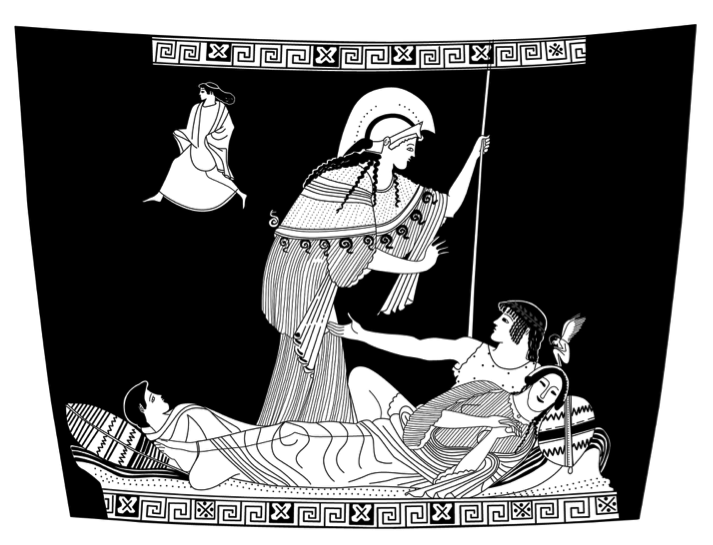
[Painting on a lekythos attributed to the Pan Painter, dated around 470 BCE (Taranto IG 4545). The line drawing, presented in rollout mode, is by Tina Ross.]
The themes in this painting are analyzed at length in Nagy 2013, “Virgil’s verse invitus, regina … and its poetic antecedents.” Also relevant is another article: Nagy, G. 2017.06.10, “Diachronic Homer and a Cretan Odyssey.” I epitomize what I have to say about this painting there at 5§§7–10:
{5§7.} This picture captures the moment when Athena appears to Theseus after he has made love with Ariadne. The couple has fallen asleep after the lovemaking, but Athena awakens Theseus, gently gesturing for him to be quiet and not to awaken Ariadne, who is held fast in her sleep by a little figure of Hypnos perched on top of her head. The details have been described this way (Oakley and Sinos 1993:37):
Here we see the couple at the moment of separation. Athena has just wakened Theseus, and as she bends over him he begins to rise, bending one leg and sitting up from the pillow on which he has lain next to Ariadne. Athena tries to quiet him as he stretches out his arm, a gesture of remonstration or inquiry. In the upper left hand corner is a small female figure flying into the night.
{5§8.} I note that the small female figure who is “flying into the night” is disheveled, with her hair flying in the wind and with her clothing in disarray. I interpret this figure as a prefiguring of Ariadne herself at a later moment, the morning after, when she wakes up to find that she has been abandoned by Theseus. I recall here the verse in Catullus 64.63 where the headdress that had held the hair of Ariadne together has now come undone, and she looks like a bacchant, a frenzied devotee of Bacchus, that is, of the god Dionysus. And it is this same Bacchic frenzy, signaled by her disheveled hair, that will now attract Dionysus to her.
{5§9.} In contrast to the morning after, when Ariadne in her Bacchic frenzy will come undone, the picture of Ariadne in the present is eerily peaceful (Nagy 2013b:161–162):
Ariadne faces us directly, an unusual pose that points to her oblivion to what is happening behind her as well as allowing us a clear view of the peaceful contentment registered on her face. Her eyes are closed tight, and she will not awaken as Theseus departs, for the figure of Hypnos, Sleep, sits on her head with legs drawn up as he sleeps.
{5§10.} Continuing to look at the picture painted on the lekythos, I draw attention to another figure. Besides the sleeping Ariadne and the little sleeping Hypnos perched on top of her head, we see also the figure of a wakeful boy reclining on the farther side of the bed, to our left, whose head is positioned directly below the miniature figure of the hovering girl with the disheveled hair. In my interpretation, this boy is Eros, who had instigated a night of intense lovemaking between Ariadne and Theseus.
subject heading(s): Odeum of Pericles; *mīmēsis *‘replica’; tent [skēnē] of Xerxes; *aitiā *‘cause’
The building next to the Theater of Dionysus, rebuilt after its destruction in first century BCE, is none other than the Odeum of Pericles, a spectacular structure that projected the glories of the Athenian Empire as the cultural heir of the Persian Empire of Xerxes. It was this ideological projection that inspired the builders of this building to give it a shape that re-enacted, as it were, the Great Tent of the King of Kings. I comment at length in HC 4§§115–124, 174–180, especially with reference to Plutarch Pericles 13.6-15. I offer here an epitome of HC4§178:
The idea of the Odeum as a visual imitation of the *Skēnē *or ‘Tent’ of the Great King of the Persian empire, as described in Plutarch’s Pericles, is a most fitting expression of imperial prestige. The Odeum, as the ‘Scene’ for the monumental Panathenaic performances of Homer in the age of Pheidias, was monumental in its own right. On the inside, its “forest of columns” matched the spectacular effect achieved at the Telestērion or Great Hall of Initiation at Eleusis. In fact, the Odeum was even more spacious than the Great Hall, and the enormous seating capacity of such a monumental building made it a most fitting venue for spectacular events of state, including juridical and political assemblies.
subject heading(s): Mount Sipylos; Magnesia-at-Sipylos
Pausanias is reminded here in passing of his homeland, Magnesia in Asia Minor, and of the mountain looming over the land. See the comment at Pausanias 1.1.1, §5, about Magnesia-at-Sipylos. This Mount Sipylos, as the dominant marker of his homeland, stays on his mind as he proceeds to reminisce, a few moments later, about the Weeping Rock of Niobe at 1.21.3.