The sanctuary [hieron] of the Dioskouroi is ancient. They themselves are represented as standing, while their sons are seated on horses. Here Polygnotus1 painted [graphein] the marriage of the daughters of Leukippos, which was [a story that was] pertinent to them [= the Dioskouroi], while Mikon painted those who sailed with Jason to the land of Kolkhis. He [=Mikon] focused his [artistic] effort on Akastos and the horses of Akastos.
Footnotes
-
↩
floruit 465 BCE.
Looming over the sanctuary [hieron] of the Dioskouroi is a sacred-precinct [temenos] of Aglauros. It was to Aglauros and her sisters, Herse and Pandrosos, that they say Athena gave Erikhthonios, whom she had in a box [kibōtos], forbidding them to pry curiously into what was entrusted to their charge. Pandrosos, they say, obeyed, but the other two opened the box [kibōtos], and went mad [mainesthai] when they saw Erikhthonios, and they threw themselves down the steepest part of the Acropolis. Here it was that the Persians [Mēdoi] climbed [up the Acropolis] and killed the Athenians who thought that they understood the oracle1 better than did Themistocles, and fortified the Acropolis with logs and stakes.2
Footnotes
Close by is the Prytaneion [‘City Hall’], in which the laws of Solon are inscribed, and statues [agalmata] are placed of the goddesses [theai] Eirene [‘Peace’] and Hestia [‘Hearth’], while among the statues-of-humans [andriantes] is Autolykos, a contestant in the pankration.1 And I say-this-because [gar] the likenesses of Miltiades and Themistocles have had their inscriptions reinscribed to refer to a Roman and a Thracian.
Footnotes
-
↩
Pausanias 1.35.6.
As one descends from here to the lower part of the city, there is a sanctuary [hieron] of Serapis, whose worship the Athenians introduced from Ptolemy. Of the Egyptian sanctuaries [hiera] of Serapis the most famous is at Alexandria, the oldest at Memphis. Into the second of these two neither stranger nor priest may enter, until they make-a-funeral-for [thaptein] Apis. Not far from the sanctuary of Serapis is the place where they say that Peirithoös and Theseus made their pact before setting forth to Lacedaemon and afterwards to Thesprotia.
Close by is built a temple [nāos] of Eileithuia, who they say came from the Hyperboreans to Delos as a helper [boēthoos] to Leto in her labor; and from Delos the name spread to other populations. The people of Delphi sacrifice [thuein] to Eileithuia and sing a hymn [humnos] of Olen. But the Cretans customarily-think [nomizein] that Eileithuia was born at Amnisos in the territory of Knossos, and that Hērā was her mother. Only among the Athenians are the wooden-figures [xoana] of Eileithuia draped [kaluptesthai] all the way to the feet. The women told me that two [of these xoana] are Cretan, being offerings [anathēmata] of Phaedra, and that the third [xoanon], which is the oldest, Erysikhthon conveyed [komizein] from Delos.
Before one enters the sanctuary [hieron] of Olympian Zeus—Hadrian ‘King’ [basileus] of the Romans dedicated [anatithenai] the temple [nāos] and the statue [agalma] [of Zeus], so worthy of viewing [théā], which in size exceeds all other statues [agalmata] except for the colossi [kolossoi] in Rhodes and in Rome, and is made of ivory and gold with an artistic skill [tekhnē] that is remarkable when the size is taken into account—before one enters, as I say, there are statues [eikones] of Hadrian, two of Thasian stone, two of Egyptian. In front of the columns [kiones] stand bronze statues that the Athenians call apoikoi poleis. The whole enclosure [peribolos] [of the precinct] is about four stadium-lengths, and it is full of statues; for every city has dedicated a likeness [eikōn] of ‘King’ [basileus] Hadrian, but the Athenians have surpassed them all in dedicating [anatithenai], in the back part of the temple, the colossus [kolossos] [of Zeus], so worthy of viewing [théā].
Within the enclosure [peribolos] are antiquities: a bronze Zeus, a shrine [nāos] of Kronos and Rhea, and a sacred-precinct [temenos] of Earth [Gē] surnamed Olympian [Olumpiā]. There is an opening in the floor here, which is the width of a cubit, and they say that it was here that the water flowed off after the cataclysm that occurred in the time of Deukalion, and into it they cast every year ground wheat mixed with honey.
On top of a column [kiōn] is a statue [andrias] of Isocrates, in whose memory [mnēmē] three things are to be noted: his being most-painstaking [epiponōtatos] in continuing to have students [mathētai] up to the end of his ninety-eight years, his being most-moderate [sōphronestatos] in keeping aloof from politics [politeiā] and from officiousness in public-affairs [koina], and his being most-devoted-to-freedom [eleutherōtatos] in dying a voluntary death, distressed as he was at the news of the battle at Khairōneia.1 There are also statues in Phrygian marble of Persians supporting a bronze tripod; both the figures and the tripod are worthy of viewing [théā]. The ancient sanctuary [hieron] of Olympian Zeus the Athenians say was built by Deukalion, and they show as a sign [sēmeion]—that Deukalion resided [oikeîn] in Athens—a tomb [taphos] that is not far from the present temple [nāos].
Footnotes
-
↩
338 BCE.
Hadrian constructed other buildings also for the Athenians: a temple [nāos] of Hērā and Zeus Panhellēnios [‘belonging to all Hellenes’], a sanctuary [hieron] that was common [koinon] to all the gods, and, most famous of all, a hundred columns [kiones] of Phrygian marble. The walls [toikhoi] too are constructed of the same material as the porticoes [stoai]. And there are rooms there adorned with a gilded roof and with alabaster stone, as well as with statues [agalmata] and paintings [graphai]. In them are kept books [biblia]. There is also a gymnasium named after Hadrian; of this too the columns [kiones] are a hundred in number, from the Libyan quarries.
subject heading(s): Erikhthonios; Kekrops; daughters of Kekrops; Aglauros, Hersē, Pandrosos; *kibōtos *‘box’; *autokhthōn *‘autochthon, one whose self is linked to the Earth’; autochthony; Battle of Gods and Giants
The mystical vision experienced by the daughters of Kekrops, as narrated here at 1.18.2 by Pausanias, is relevant to the identity of Kekrops himself, their father, whose form is human from the waist up and serpentine from the waist down. To say it in Greek: Kekrops is *diphuēs *‘double-natured’ (scholia for Aristophanes Wasps 438): he is half human, half snake. This biformity of Kekrops is shown clearly in some ancient visual representations. In the picture I show here, for example, we see Kekrops in attendance at the moment when Gaia/Gē the Earth Mother hands over to Athena the infant Erikhthonios:
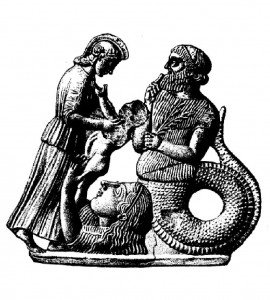
[Melian clay relief, about 460 BCE. Gaia offers Erichthonios to Athena. On the right, Kekrops. Image via Wikimedia Commons.]
The half-human and half-snake identity of Kekrops here is a sign, I argue, of the shock experienced by the daughters of Kekrops in seeing an Earth-born baby that is likewise half-human and half-snake. The girls are looking at the true form of a true autokhthōn, an autochthon. The word means literally ‘one whose self is linked to the Earth’. Here is a ‘self’ who is literally born of the Earth, of the khthōn. But what about the girls themselves? What about their own selves? What about their own humanity? Having a father like Kekrops, should the girls not expect to be biform themselves? Perhaps, then, the realization that the Earth-born baby is biform leads to the girls’ self-realization, that they, too, must be biform. It is I think the suddenness of such a self-realization that drives them mad.
The biformity of an autochthon can also be a kind of bivalence. When we get to Pausanias 1.24.7, we will see that Erikhthonios himself can be visualized not only as half-snake but also as all-snake. Pausanias himself experiences such a visualization at 1.24.7 when he is describing the colossal gold-and-ivory statue of Athena Parthenos inside the Parthenon. Pausanias sees there, with his own eyes, the hero Erikhthonios standing next to the goddess, and the hero here is all-snake, seen in his fully serpentine glory. But in other contexts of Athenian myth, as I will note when I get to my comment on Pausanias 1.24.7, Erikhthonios can also be visualized as all-human, not only as all-snake. I should add that, in our own non-Greek way of thinking, our comfort level with the human form of this hero can lead to an accentuation of the human side even at the moment when the primal biformity of the baby Erikhthonios is first discovered. A relevant painting by Rubens captures beautifully an accentuation of the baby’s human side, despite the clear visual markers of his serpentine side:
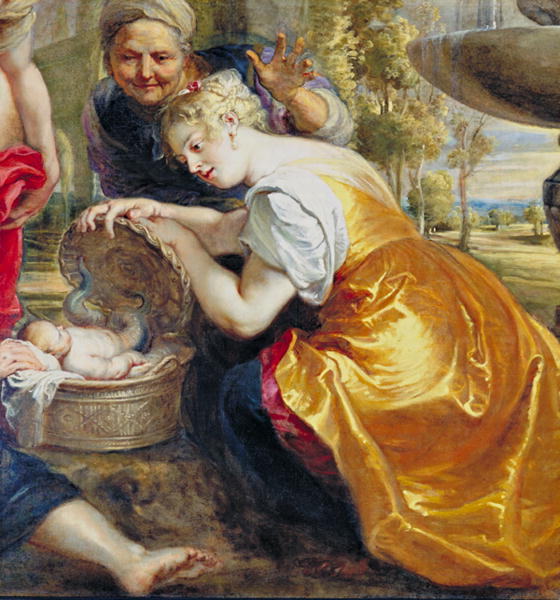
[Finding of Erichthonius (1632/1633). Peter Paul Rubens (Dutch, 1577–1640). Image via Wikimedia Commons.]
As for the ground-level human condition of being born half-human and half-snake, I think we see at work a normalization of this primal biformity in the myth about the Battle of Gods and Giants, where the gods are seen in their all-human form—though this form is of course far greater in proportion to our everyday human form— while the giants, once they start losing the battle, are visualized in the process of undergoing a metamorphosis: they are changing in form from all-humans to half-snakes and then to all-snakes. I epitomize here from my relevant formulation in HC 1§§131–132:
{1§131.} Once the earth-born giants start to lose their struggle against the sky-born gods of Olympus, their legs begin to turn into serpents. In surviving pictorial representations of the Gigantomachy, some of the struggling giants are shown still having human legs to stand on while others of the giants are already showing serpents where we expect to see legs, and I interpret this variation as a dynamic representation of their devolution—from the status of aspiring sky-dwellers back to the status of the earth-bound denizens they really are.
{1§132.} Once the Olympian gods start winning the battle, the giants find themselves having no leg to stand on. Their resistance collapses. The twin serpents we see extending from their lower bodies may now be allowed to follow the natural instincts of serpents and slip back, head first, into the hollows of the same mother Earth that had generated them in the first place.